In modern manufacturing, aluminum spot welding has become a critical process for industries focused on lightweight structures, EV production, and high-strength assemblies. However, aluminum’s high thermal conductivity, oxide layer, and rapid heat dissipation make it significantly more challenging than steel. An aluminum spot welder must therefore deliver exceptional current control, stable energy output, and precise electrode force management to achieve consistent weld quality.
For OEMs, automation integrators, and production engineers, understanding how aluminum spot welding works and how advanced systems solve its challenges is essential for improving productivity and weld reliability.
What Is an Aluminum Spot Welder?
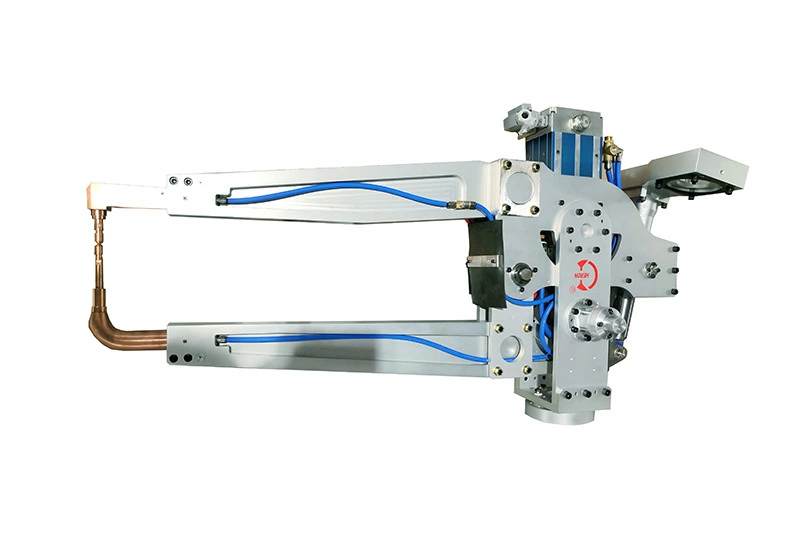
An aluminum spot welder is a resistance welding system designed to join aluminum sheets by applying controlled current, pressure, and time through copper electrodes.
The process is based on Joule heating, where electrical resistance generates localized heat at the faying surfaces, forming a weld nugget. However, aluminum requires much higher current and tighter process control compared to steel due to:
- High electrical conductivity
- Fast heat dissipation
- Stable oxide layer (Al₂O₃)
- Narrow welding process window
According to resistance welding principles, heat generation follows Q = I²Rt, meaning even small variations in current or resistance can drastically affect weld quality.
How Aluminum Spot Welding Works (Process Principle)
Aluminum spot welding typically follows a three-stage controlled cycle:
1. Pre-squeeze Stage
Electrodes apply force (typically 1000–2000N) to ensure intimate contact between aluminum sheets. This step helps break partial surface irregularities and stabilizes electrical resistance.
2. Heating Stage
A high-current pulse (often 25–80 kA depending on thickness) flows through the material. Heat is generated at the interface, forming a molten weld nugget within milliseconds.
Because aluminum rapidly conducts heat away, the system must deliver energy extremely quickly to avoid incomplete fusion.
3. Forge and Cooling Stage
Current stops while electrode force is maintained. This compresses the molten nugget, reducing porosity and ensuring solidification under pressure.
This fast-cycle, high-energy process is what distinguishes an aluminum spot welder from conventional steel welding systems.
Why Aluminum Is Difficult to Spot Weld
Aluminum introduces several engineering challenges that directly affect weld quality and consistency:
1. Oxide Layer Instability
Aluminum naturally forms an oxide layer with a melting point (~2050°C) far higher than aluminum itself (~660°C). This barrier increases contact resistance variation and reduces weld predictability.
2. High Thermal Conductivity
Heat spreads rapidly away from the weld zone, requiring significantly higher energy input to maintain fusion.
3. Process Sensitivity
Small variations in electrode force, surface condition, or current can cause:
- Expulsion (molten metal splash)
- Weak nugget formation
- Porosity or incomplete fusion
4. Electrode Wear
Higher currents accelerate electrode degradation, increasing maintenance costs and reducing production stability.
MFDC Technology: The Industrial Standard for Aluminum Spot Welding
Modern manufacturing rarely relies on traditional AC spot welding for aluminum. Instead, MFDC (Medium Frequency Direct Current) systems are preferred.
Why MFDC aluminum spot welders outperform AC systems:
- Stable DC output (no zero-crossing loss)
- Higher thermal efficiency (>90%)
- Precise millisecond-level current control
- Lower spatter and improved surface quality
- Reduced electrode wear
These advantages allow MFDC systems to maintain consistent nugget formation even under variable surface conditions, making them ideal for automotive and EV production lines.
Industrial Applications of Aluminum Spot Welding
1. Automotive Manufacturing
Aluminum spot welders are widely used in:
- EV battery trays
- Body-in-white structures
- Lightweight chassis components
Automakers rely on aluminum welding to reduce vehicle weight while maintaining crash safety standards.
2. Aerospace Engineering
Used for:
- Aircraft panels
- Structural brackets
- Lightweight enclosures
Precision and repeatability are critical in these applications.
3. Rail and Transportation Systems
High-strength aluminum assemblies are used for:
- Carriage bodies
- Structural reinforcements
- Energy-efficient transport designs
4. Electrical & Energy Systems
Includes:
- Busbars
- Enclosures
- Battery interconnects
Best Practices for Aluminum Spot Welding
To achieve stable production results, engineers should focus on the following:
1. Surface Preparation
Cleaning is essential. Removing oil, dust, and oxide improves weld consistency.
2. Electrode Design
Use:
- Larger electrode tips for better heat distribution
- Copper alloys with high thermal conductivity
- Regular dressing schedules
3. Optimized Welding Parameters
Key variables include:
- Current amplitude
- Weld time (typically very short cycles)
- Electrode force
- Upslope/downslope control
4. Machine Stability
Automation systems with closed-loop control ensure consistent quality across high-volume production.
How Heron Supports Aluminum Spot Welding Solutions
As a global manufacturer of industrial welding systems, Heron Welder designs advanced solutions for aluminum joining challenges, including:
- MFDC resistance spot welding machines
- Automated welding production lines
- Precision welding guns and controllers
- Clinching and FSPR riveting systems for hybrid joining
Heron systems are engineered for:
- High-current stability
- Smart process control
- Reduced electrode wear
- Integration into automated production lines
This makes them suitable for demanding OEM environments where consistency, speed, and quality are critical.
FAQs: Aluminum Spot Welder
1. Can aluminum be spot welded effectively?
Yes, but it requires high current, precise pressure control, and often MFDC technology for stable results.
2. Why is aluminum harder to weld than steel?
Because of its oxide layer, high thermal conductivity, and sensitivity to heat input variations.
3. What type of spot welder is best for aluminum?
MFDC resistance spot welders are the most widely used in industrial applications due to their stability and efficiency.
4. What industries use aluminum spot welding the most?
Automotive, EV manufacturing, aerospace, rail transportation, and electrical industries.
5. How can weld quality be improved in aluminum spot welding?
Through proper surface cleaning, optimized electrode design, controlled parameters, and advanced welding control systems.
Conclusion
An aluminum spot welder is not just a joining tool it is a precision-controlled industrial system that directly impacts product strength, manufacturing efficiency, and long-term reliability. With aluminum becoming increasingly important in lightweight design strategies, the demand for advanced resistance welding solutions continues to grow.
For manufacturers seeking stable, high-performance aluminum welding systems, advanced MFDC technology and automation integration are essential.
Heron Welder provides customized resistance welding and automation solutions designed for demanding aluminum applications across automotive, aerospace, and industrial production lines.
Contact Heron today to request a quote or consult with our engineering team for a tailored aluminum spot welding solution.




 Arabic
 French
 Spanish
 Portuguese
 Deutsch
 Türkçe
 Dutch
Dutch
 Italiano
 Russian
 Romaian
 Portuguese (Brazil)
 Greek
Greek